
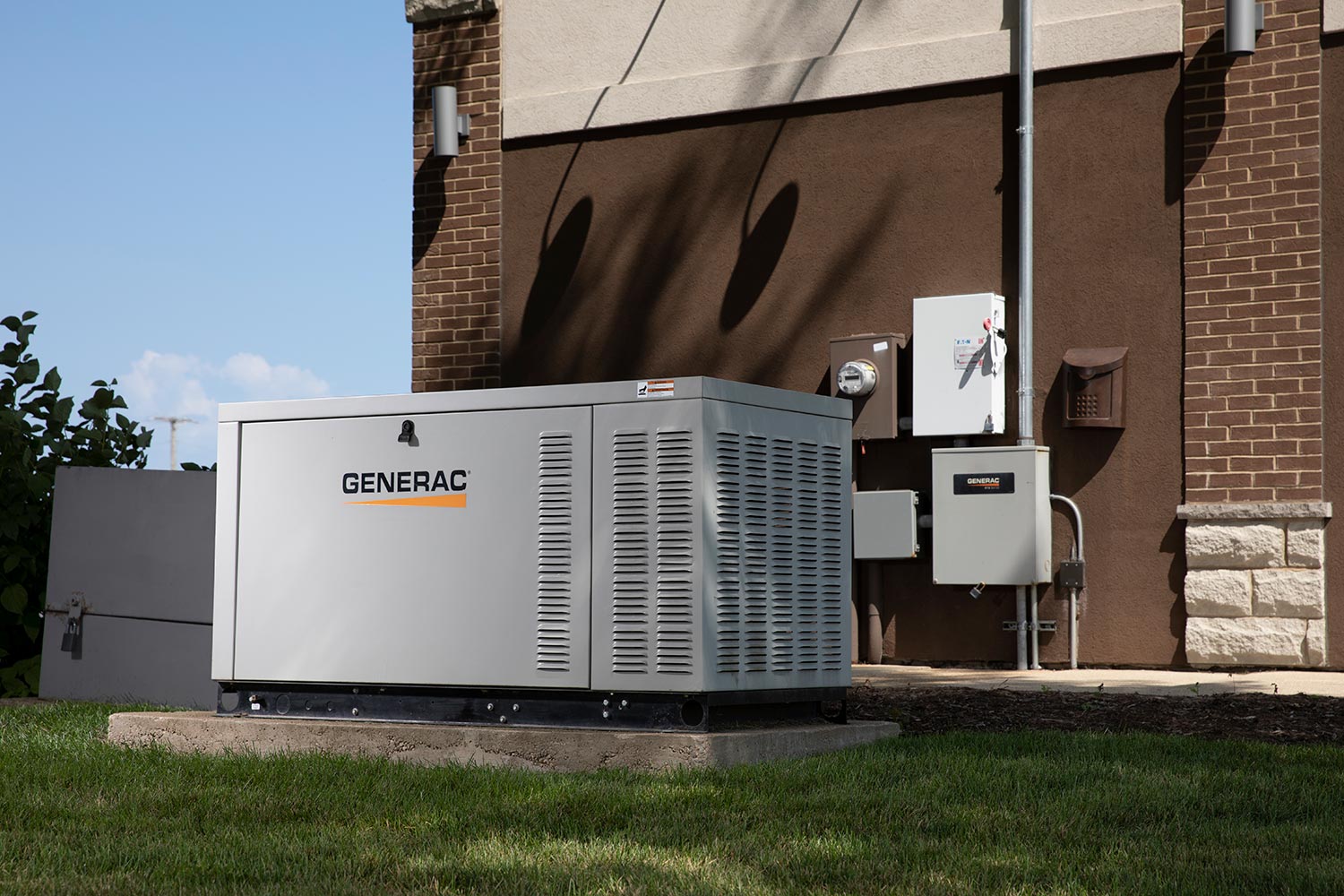
Protector series, 22 to 60 kW
Liquid‑cooled Generac generators, explained by the people who install them.
A liquid-cooled Generac is the unit for a house that an air-cooled generator cannot carry: the estate with a guest house and pool equipment, the home with three or four air conditioning systems, the property on a well with an electrified kitchen. County Line Electric sizes, permits, installs and services them from the Conejo Valley to Malibu and Montecito. This page says what the spec sheets say, and what over 20 years of job sites add to it.
The short answer
Air-cooled runs a house. Liquid-cooled runs an estate.
Every standby generator is an engine turning an alternator. The difference in the name is how the engine sheds heat. An air-cooled Generac pushes air across the engine with a fan, the way a lawn tractor does, which is simple, compact and right for most homes. A liquid-cooled Generac has an automotive-style cooling system: a radiator, a water pump, a thermostat and coolant in the block, around a 2.4 liter engine on the 22 to 60 kW units. It runs cooler under heavy load, runs longer at full output, and is built for the kind of duty an estate puts on it during a three-day shutoff.
The decision is not about square footage. It is a load calculation: the sum of what has to keep running at the same moment, with the starting surge of the biggest motors on top. A 6,000 square foot house with gas appliances and two air conditioners may be an air-cooled job. A 4,000 square foot house on a well, with a pool, an electrified kitchen, a guest house and an EV charger may not be. County Line does the calculation at the site visit and puts the unit on the estimate with the numbers beside it, so you can see why.
The lineup
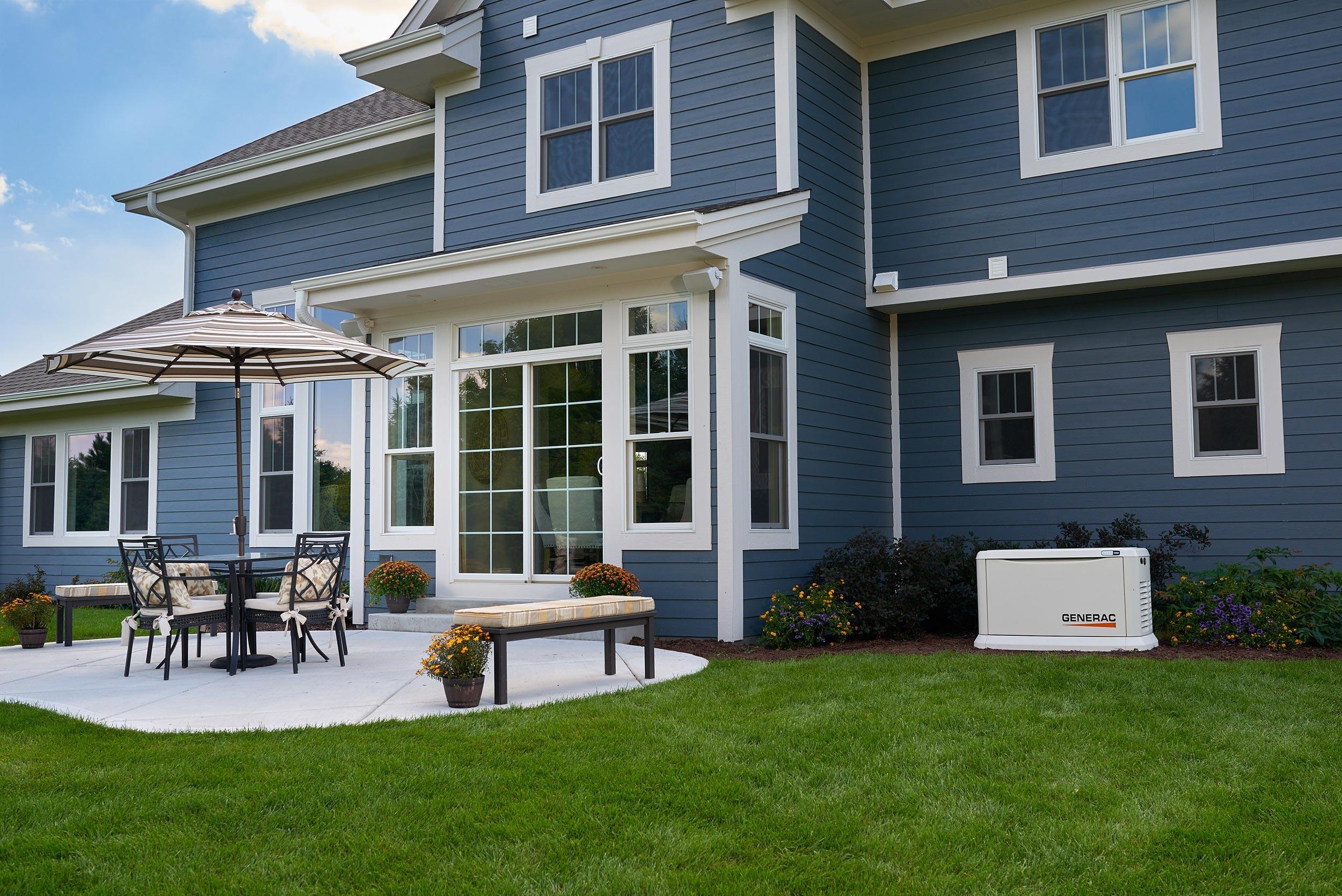
Generac Protector series, liquid-cooled, 22 to 60 kW.
From Generac's own specification sheets, linked at the foot of this page. Standby ratings; Generac notes the average output over 24 hours should not exceed 70 percent of the rating, which is one reason an estate is sized with margin.
| Model | Rating | Engine | Sound at exercise, 23 ft | Unit weight |
|---|---|---|---|---|
| RG02224 | 22 kW | 2.4 L, liquid-cooled | 61 dB(A) | 905 lb |
| RG02724 | 27 kW | 2.4 L, liquid-cooled | 61 dB(A) | about 905 lb |
| RG03224 | 32 kW | 2.4 L, liquid-cooled | 58 dB(A) | 1,225 lb |
| RG03824 | 38 kW | 2.4 L, liquid-cooled | 58 dB(A) | 1,235 lb |
| RG04524 | 45 kW | 2.4 L, liquid-cooled | 61 dB(A) | 1,313 lb |
| RG06024 | 60 kW | 2.4 L, liquid-cooled | 65 dB(A) | 1,230 to 1,283 lb |
Larger Protector units, 48, 60 and 80 kW on a 4.5 liter four-cylinder engine, exist for commercial and the very largest residential loads; County Line quotes them when the load calculation calls for one. All Protector units carry a five-year, 2,000-hour limited warranty, a corrosion-resistant aluminum enclosure, UL 2200 listing, digital voltage regulation at plus or minus one percent, and cellular Mobile Link monitoring. The 22 and 27 kW models are available in California emissions-compliant versions, which matters: the unit has to be the California version or it cannot be permitted here. Generac product imagery. Generac is a trademark of Generac Power Systems.
When an estate needs one
Five loads that push a house past air-cooled.
Well and booster pumps
Common above the valley floor and along the Malibu coast. A pump motor draws several times its running current for a moment at start. Two pumps starting together is the surge that sizes the unit.
Three or more air conditioning systems
Estates in Hidden Hills, Westlake and Montecito often run four. A shutoff lands in the hottest week of the year, and the owner expects every zone to work.
Pool and spa equipment
Variable-speed pumps, heaters, and the lighting and automation around them. Usually on a subpanel of its own, which the transfer switch has to carry.
The electrified kitchen
Induction ranges, two ovens, warming drawers, a second refrigerator and the freezer in the garage. Electrification is good for the house and hard on a generator sized by square footage.
Guest house, gate, EV chargers
A second dwelling, the motorized gate that has to open ahead of a fire, and one or two Level 2 chargers at 40 to 60 amps each. County Line can manage charger loads so they wait, but the house still needs the headroom.
Days, not hours
A Public Safety Power Shutoff runs until the wind drops and the lines are patrolled. A liquid-cooled unit is built to run at high load for that long. An air-cooled unit will run, but at the edge of what it was designed for.
Fuel
Natural gas where there is a main. Propane where there is not.
A liquid-cooled Generac runs on natural gas or propane, and the fuel decides a surprising amount of the installation. On natural gas the question is pressure and pipe size: a 38 kW unit at full load draws far more gas than a furnace, and the run from the meter has to be sized for it. County Line checks the meter capacity with the gas utility before the estimate is written, because a meter upgrade changes the schedule. On propane the question is tank size and vapor rate: a 60 kW unit at rated load uses propane fast, a tank sized for a barbecue will not keep up in cold weather, and the supplier has to be able to reach the tank on a shutoff day when the roads up the canyon are busy.
Generac publishes consumption at no load, half load and full load for each unit in the spec sheet. County Line uses those figures with your actual load calculation to size the tank or confirm the gas line, and writes the figure on the estimate. That is the number to ask any installer for. If it is not on the quote, nobody has done the arithmetic.
The installation
What a liquid-cooled installation involves, in order.
- 01
Load calculation and site visit
Panel, subpanels, pumps, HVAC nameplates, gas meter, the yard, the setbacks, the neighbors. The written estimate follows.
- 02
Placement
Manufacturer clearances from openings and property lines, the local building department, the HOA where there is one, and the Coastal Zone in Malibu. A liquid-cooled unit is larger and heavier than an air-cooled one, so the pad and the path to it matter.
- 03
Permits and the gas utility
County Line pulls the electrical permit. Gas work is coordinated with a licensed plumber or your propane supplier, and the meter capacity is confirmed with the utility.
- 04
Pad, set and transfer switch
A concrete pad to Generac's minimum, the unit craned or rolled in, the automatic transfer switch at the service, and the conduit between them. On an estate this may mean more than one transfer switch or a load-management setup.
- 05
Connection, startup, inspection
Gas and electrical connections, startup, a simulated outage with you watching every circuit come back, and the inspection.
- 06
Service, twice a year
A liquid-cooled unit adds coolant, hoses and the radiator to the usual oil, filters, battery and load test. County Line services the units it installs and units other contractors installed.
Sound
Quieter than the neighbors expect, and the enclosure is why.
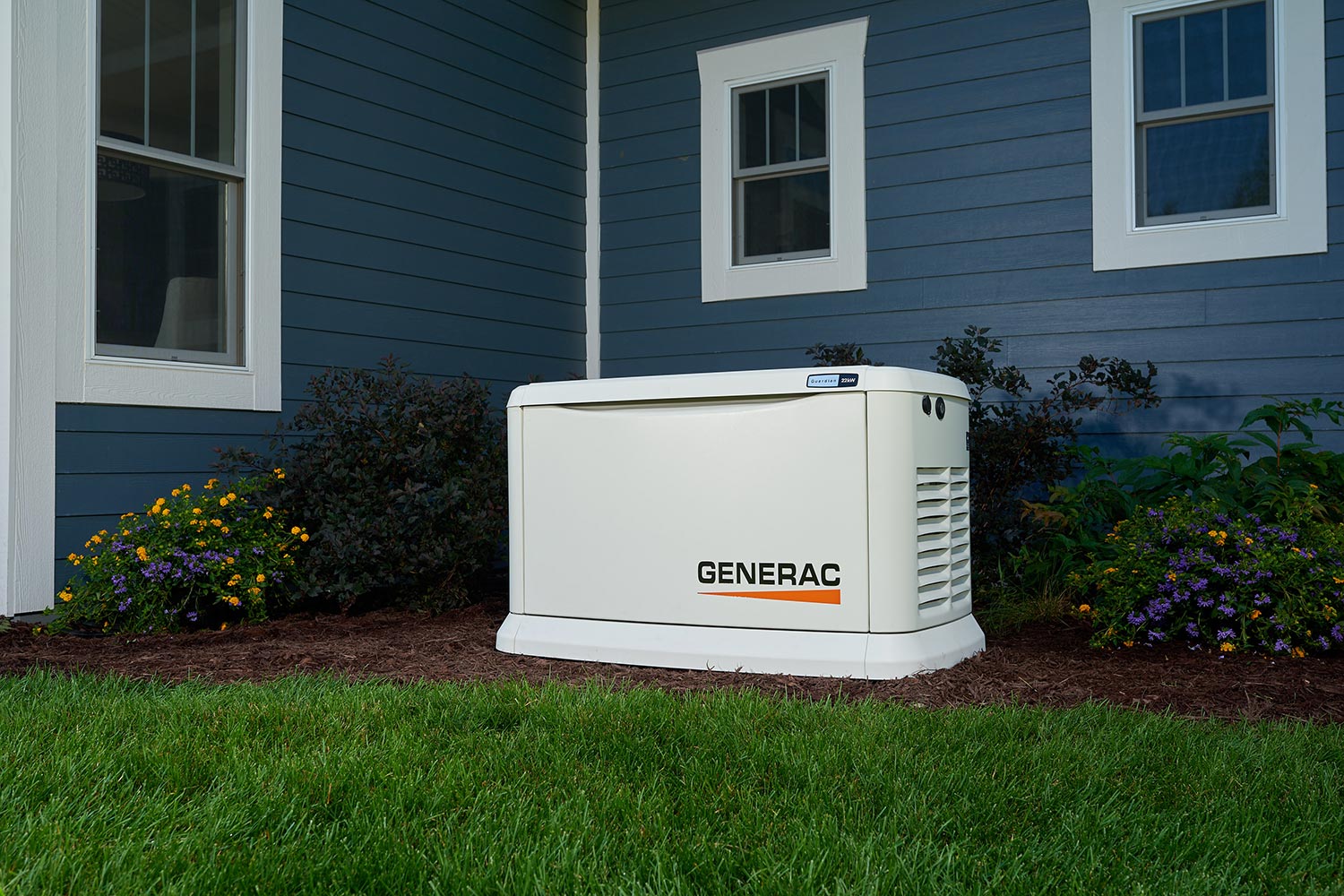
The sound figures in the table are Generac's, measured at 23 feet during the weekly exercise cycle: 58 to 65 dB(A) depending on the unit, which is roughly a normal conversation. At operating speed under load the units are louder, 64 to 73 dB(A) at the same distance. The sound-attenuated aluminum enclosure does most of the work; placement does the rest. County Line places the unit where the exhaust and the radiator discharge face away from bedrooms and the neighbor's patio, and where the weekly exercise will not become a complaint to the HOA.
Two honest notes. First, a liquid-cooled unit is not silent, and anyone who tells you otherwise has not stood next to one at full load. Second, the exercise cycle can be scheduled for a time of day nobody minds, and Mobile Link lets the office confirm it ran.
County Line Electric at a glance
- 20+ yrsIn businessJeff Tucker has run County Line Electric in the Conejo Valley for over 20 years.
- #949580California contractor licenseLicensed, bonded and insured. Check it on the CSLB site any time.
- GeneracStandby generator estimatesA written estimate after a site visit and a load calculation.
- A+BBB Accredited since 2017Rated A+ by the Better Business Bureau. See the profile.
- 5.0HomeAdvisor ratingFive stars from every reviewed job. Read the reviews.
Liquid-cooled questions
How much does a liquid-cooled Generac cost installed?
The installed cost of a liquid-cooled Generac depends on the unit, the fuel, the gas line or tank, the transfer switch arrangement and the pad location, which is why County Line does not publish a price list. What it does publish is the method: a site visit, a load calculation, and a written estimate with the unit, the fuel figures and the scope on it. The twice-yearly service plan is $600 a year, both visits.
Is a liquid-cooled generator better than an air-cooled one?
It is better at carrying large loads for a long time. It is not better for a house that does not need that. For most homes under about 4,000 square feet with gas appliances, an air-cooled Generac is the right unit and the liquid-cooled one is money spent on capacity that never gets used. The load calculation decides, not the brochure.
What size liquid-cooled generator does an estate need?
The 22 to 38 kW Protector units cover most large homes in the Conejo Valley, Calabasas and Malibu. Estates with multiple structures, several air conditioning systems and pumps move into the 45 and 60 kW units. County Line sizes from the nameplates on your equipment and the starting surge of the largest motors, with margin for the days-long duty of a shutoff.
Can a liquid-cooled Generac run on propane?
Yes. The 22 to 48 kW units ship configured for natural gas and are reconfigured for propane in the field; the 60 kW unit is ordered for one fuel. Propane needs a tank sized from Generac's published consumption figures and a supplier who can reach it in fire season. County Line sizes the tank on the estimate.
Does County Line install liquid-cooled generators in Malibu?
Yes. Malibu adds the Coastal Zone to the permit path and often puts the unit on propane because there is no gas main. County Line has installed standby generators across the Malibu coast and canyons and handles both.
How often does a liquid-cooled generator need service?
Twice a year, plus after any extended run. The weekly exercise cycle keeps it ready; the service keeps it alive: oil and filters, coolant and hoses, the battery, a load test and the transfer switch. County Line services the units it installs and units installed by others.
Generators
Official references
Where the facts on this page come from.
County Line links to the authorities rather than restating them. Rules change; these pages are current.
- Generac Protector series 22 to 60 kW specification sheet (PDF): the ratings, sound, weights, warranty and fuel figures above
- Generac Protector series 48, 60 and 80 kW specification sheet (PDF): the 4.5 liter units
- Generac: backup generator installation: the manufacturer's own account of an installation
- Generac home standby generators: the current lineup
Next step
Estate, guest house, pumps, pool? Start with the load calculation.
Name, phone, city. County Line visits the site, calculates the load and writes the estimate, with the unit and the fuel figures on it.
Or call (805) 499-0823. Monday to Friday, 9 to 5.