
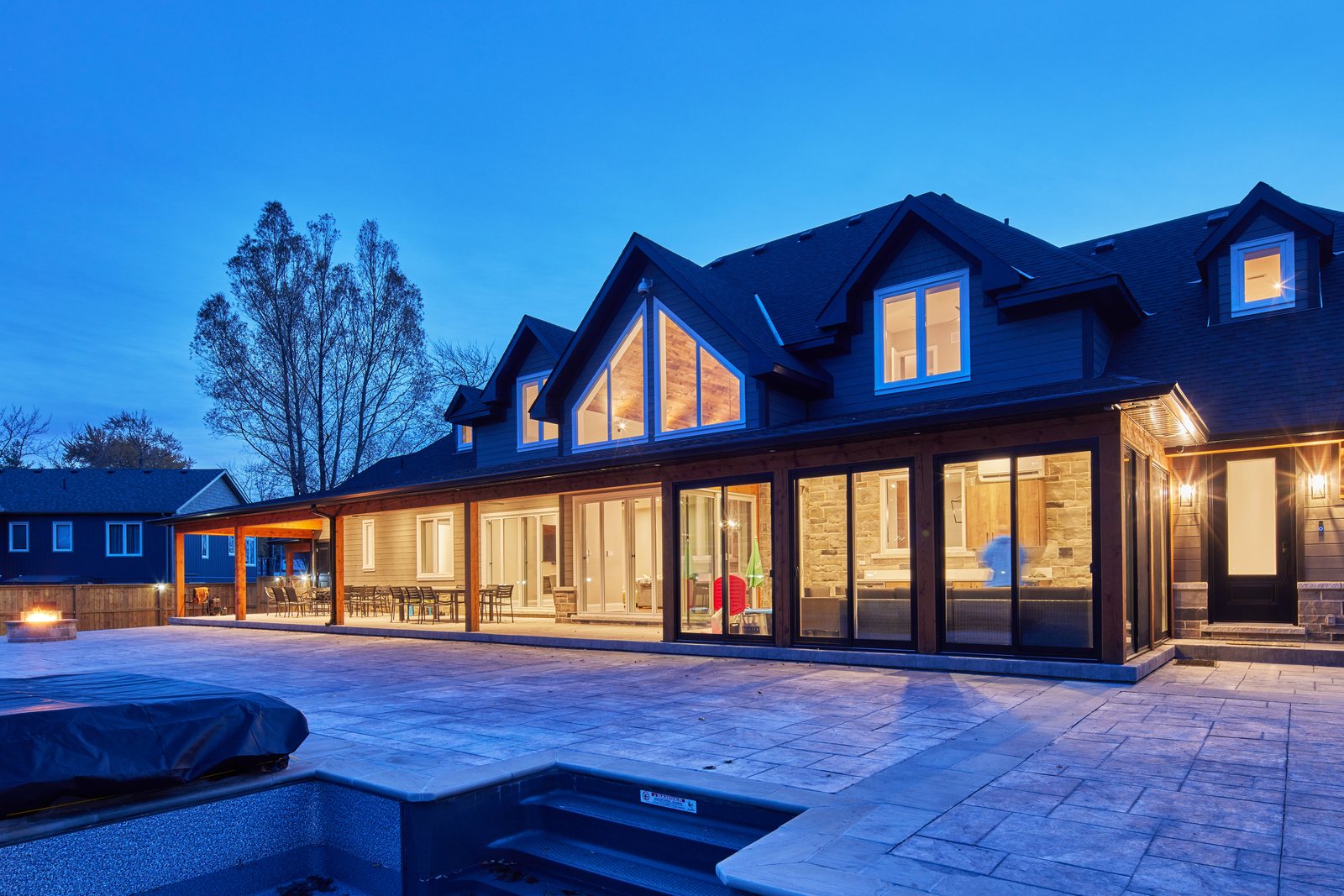
The house that runs itself
Residential Microgrid: the house that keeps running when the grid does not.
A residential microgrid is a home whose generator, battery, solar, EV charger and electrical panel are designed as one system, so that when Southern California Edison or LADWP turns the power off, the house does not notice. County Line Electric designs and installs residential microgrids from the Conejo Valley to Malibu, the Palisades and Montecito.
What it is
One electrical design, five pieces of equipment, and a house that decides for itself.
For a century a house had one source of power, the wire from the street, and everything inside it was a load. That is no longer true in the hills and canyons County Line works in. A current custom home in Malibu, Hidden Hills or Montecito can have a Generac standby generator on a pad, a battery on the garage wall, solar on the roof, a Tesla Wall Connector that can push power from the car back into the house, and an electrical panel that knows which circuits matter. Each of those is sold separately by a different company. A residential microgrid is what you get when an electrical contractor designs them as one system, with one set of rules for what happens the moment the utility drops.
The word comes from the utility world, where a microgrid is a section of the grid that can island itself and keep running. A residential microgrid is the same idea at the scale of one property: a boundary at the service entrance, sources behind it, loads behind it, and a controller that disconnects from the utility, keeps the sources and loads in balance, and reconnects when the grid is back. The transfer switch, the battery inverter and the smart panel are each a piece of that controller. Getting them to agree is the electrical work.
This matters here more than almost anywhere in the country because the outages are a policy, not an accident. Southern California Edison and LADWP de-energize lines in high fire hazard areas during wind events under Public Safety Power Shutoff rules set by the California Public Utilities Commission, and a shutoff can last several days once the inspection of every line is counted. A house in the Santa Monica Mountains, the Conejo hills or the Montecito foothills will spend days every year without utility power for as long as those lines run where they run. This design is the electrical answer to that fact.
The five pieces
What a residential microgrid is made of.
Standby generator
The piece that carries a house for days. Generac air-cooled or liquid-cooled, on natural gas or propane, started by an automatic transfer switch.
GeneratorsBattery storage
Instant, silent and clean for the first hours. Covers the gap before the generator starts and lets the generator rest overnight.
Generator and batterySolar
Recharges the battery through a multi-day shutoff. Without a battery and the right inverter, solar shuts off with the grid.
Solar and backupBidirectional EV charging
A Tesla with Powershare or a compatible EV is a battery on wheels. The Wall Connector and the home gateway make it part of the house.
EV as the batterySmart panel and load management
The panel that knows the well pump matters more than the pool heater, and acts on it automatically.
Load managementThe electrical design
Service sizing, transfer switching, critical-loads layout, interconnection with the utility, permits and inspection. The part that makes the pieces a system.
Permits and the utilityWhy one contractor
Five vendors, one failure mode.
The usual way a house ends up with these pieces is one at a time, from five different installers. The solar company sets the inverter to shut down when the grid drops, because that is the safe default. The generator company puts a transfer switch ahead of the whole panel. The battery company wires a critical-loads subpanel with a different idea of what is critical. The EV charger is on a 60 amp breaker the generator was never sized for. Nothing is wrong with any one of those installations, and the first real shutoff reveals that they were never designed to run together: the generator starts and the battery inverter disconnects, or the EV charger pulls the generator into overload at two in the morning.
County Line Electric is the licensed electrical contractor on the whole system. The company installs and services Generac standby generators, is a Tesla Certified Installer for the Wall Connector and the Powershare home equipment, and has wired custom homes for builders in Malibu, the Palisades and the Conejo Valley for over 20 years. The load calculation, the one-line diagram, the transfer scheme, the panel layout and the permit are done once, by the contractor who will be standing in the garage when the inspector arrives and when the first wind event comes.
The result is not a product. It is a sequence of decisions about one house: what has to stay on, for how long, from which source, in what order, and what the owner should never have to think about. The ten pages below walk through those decisions one at a time, including the one about when the whole idea is more than a house needs.
How it is designed
Six steps from the panel to a house that islands itself.
- 01
The outage brief
What has to stay on, for how long, with whom in the house. The well, the gate, the medical equipment, the freezer, the network, the chargers.
- 02
Load calculation
Every circuit that matters, with its starting and running load, against the sources that will carry it. This decides generator size, battery size and whether the service needs to grow.
- 03
Source plan
Generator, battery, solar, the car. Which one covers the first seconds, the first night, the third day. Natural gas or propane. Where each piece physically goes, with clearances and the HOA.
- 04
The one-line and the transfer scheme
Transfer switch placement, the critical-loads layout or the smart panel, inverter settings, the gateway. The drawing the inspector and the utility both see.
- 05
Permits and interconnection
Electrical permit with the city or county, the utility interconnection for anything that exports, the gas work by a licensed plumber, the Coastal Zone in Malibu.
- 06
Install, test, teach
Set, wire, commission, then pull the main with the owner watching and let the house do what it was designed to do. Then the twice-yearly service.
County Line Electric at a glance
- 20+ yrsIn businessJeff Tucker has run County Line Electric in the Conejo Valley for over 20 years.
- #949580California contractor licenseLicensed, bonded and insured. Check it on the CSLB site any time.
- GeneracStandby generator estimatesA written estimate after a site visit and a load calculation.
- A+BBB Accredited since 2017Rated A+ by the Better Business Bureau. See the profile.
- 5.0HomeAdvisor ratingFive stars from every reviewed job. Read the reviews.
The series
One question at a time.
One question at a time: each page in the residential microgrid series answers a single part of the design.
- Designed for the shutoffsThe outage is the design brief
- Generator and battery togetherWho carries what, and when
- Bidirectional EV chargingThe car as the battery
- Smart panels and load managementDeciding what stays on
- Solar inside the microgridWhy panels alone go dark
- The all-electric houseTitle 24 and the service size
- Canyon and coast homesPropane, wells, gates, days
- Permits and the utilityInterconnection and inspection
- Keeping it readyA system that is never tested fails
- When it is too muchThe honest page
Residential microgrid questions
What is a residential microgrid?
A residential microgrid is a home that can run on its own power when the utility is down. Its power sources, usually a standby generator, a battery, solar and sometimes a bidirectional EV charger, and its electrical panel are designed as one system that disconnects from the utility during an outage, keeps the chosen loads running and reconnects when the grid returns. County Line Electric designs and installs residential microgrids in Ventura, Los Angeles and Santa Barbara counties.
Is a residential microgrid the same as a generator or a battery?
No. A generator or a battery is one source. A residential microgrid is the electrical design that makes several sources and the panel work together automatically, so the generator, the battery, the solar and the EV charger do not fight each other when the grid drops.
Do I need all five pieces?
No. Most residential microgrids County Line designs start with a generator and a smart transfer scheme, and add a battery, solar or bidirectional charging when the house and the owner need them. The load calculation decides, not a package.
Does County Line Electric install Tesla Powershare equipment?
Yes. County Line Electric is a Tesla Certified Installer and installs the Tesla Wall Connector and the home equipment that lets a compatible Tesla power the house, as part of a residential microgrid design or on its own.
Where does County Line do this work?
County Line does residential microgrid work across its service area from the office in Newbury Park. The areas include Thousand Oaks, Westlake Village, Agoura Hills, Calabasas and Hidden Hills, Malibu, Topanga, Pacific Palisades, Brentwood, Bel Air, Beverly Hills, Studio City, Camarillo, Ventura, Santa Barbara and Montecito, with the shutoff-prone hill and canyon neighborhoods first.
Official references
Where the facts on this page come from.
County Line links to the authorities rather than restating them. Rules change; these pages are current.
- SCE Public Safety Power Shutoffs: the outages this design answers
- California Public Utilities Commission on PSPS: the rules the utilities follow
- Fire Hazard Severity Zones: the map that decides which circuits are shut off
- Tesla Powershare: bidirectional charging that lets the car power the house
- Generac: the standby generators County Line installs
- CSLB license check: license #949580
Next step
Tell us what has to stay on.
Tell us what has to stay on when the grid is off: the well, the gate, the kitchen, the chargers, with your name, phone and city. Jeff walks the panel and the yard, then the design conversation starts.
Or call (805) 499-0823. Monday to Friday, 9 to 5.